Starbuck’s massive coffee chain beginning in the United States reaches various continents. In 2000, they took on the Australian coffee market and quickly opened 87 locations within 7 years. Australia’s appeal was their large coffee market, strong economy, and Starbuck’s previous accomplishments within international markets. However, Starbuck’s failed to gain popularity among Australians and closed 61 stores in 2008.
Starbuck’s failed to adapt within Australia’s current coffee culture established by Italian and Greek immigrants. Australians enjoyed espresso drinks and quality tastes, which did not align with Starbuck’s sugary drink menus. Starbucks did not adjust their menu and copied their American version, as they assumed Australians had similar tastes. Starbucks emphasizes convenience and quick to-go coffee. This did not attract Australians, because they visited coffee shops to sit down and socialize. Aside from Australians need to have a coffee experience, the prices were overpriced and not worth investing in.
Australia’s coffee market was competitive, because they had many local coffee shops around every corner. On average, Starbucks charged at most one dollar higher than its competitors. Starbucks already did not fit their coffee culture and in addition they expected their consumers to pay higher prices for drinks. Many customers preferred just going to their own local and everyday coffee shops. It is also good to note that 2008 was the beginning of the Global Financial Crisis. Starbucks kept their prices the same and this did not help bringing in customers.
Some current reference price complaints included:
- Average coffee cup is between 4-4.50 and a Venti sized drink is around 6.50 AUD. (Robert Nyguen)
- However, Starbucks charges about 7.10 AUD for a Venti vs a competitor example charge of 6.50 AUD. (Robert Nyguen)
- Local Australian coffee shops charge about 3.50 for a large flat white versus Starbucks charging 4.40. (Benedict Brook)
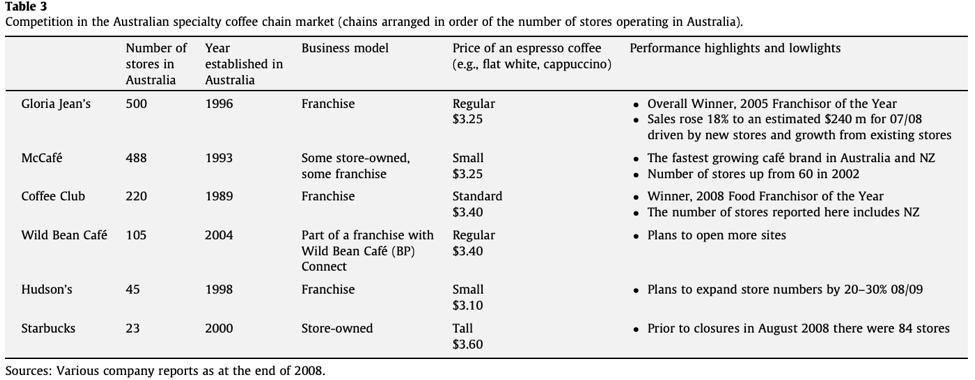
In conclusion, Starbucks overestimated their popularity and ability to expand within Australia. They saw an opportunity to take over a large market, but did not consider the culture or how many shops were already in Australia. From some of the available price comparisons, they selected to over-price their competitors. Stabilizing their prices or putting out competitive prices could have helped draw in new customers. Starbucks had the experience and team to adapt within the market, but they seemed to think that the population may be similar to American culture. Today, Starbucks continues survive in Australia by targeting international crowds that are loyal customers and students living in Australia.
References:
https://sysyamnos0915.files.wordpress.com/2013/05/1-s2-0-s1441358209000949-main.pdf